

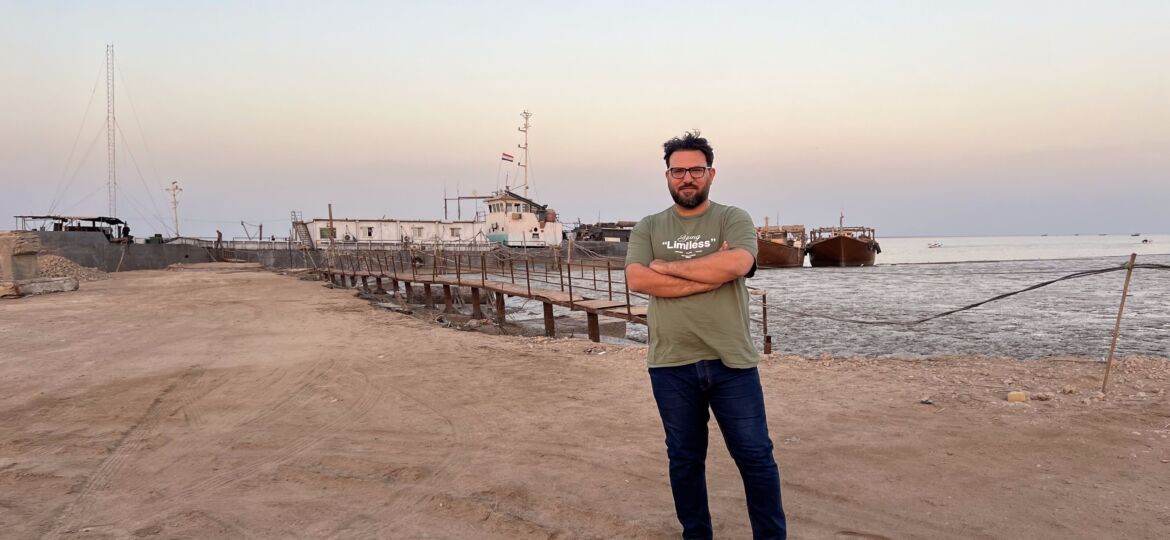
Press freedom is at its lowest point since 2012. RSF’s 2026 World Press Freedom Index paints a stark picture: across every region of the world, journalists face criminalisation, exile, detention, and violence. In the Middle East and North Africa, the most dangerous region for press freedom — Iraqi journalists work in an environment where bearing witness can cost you everything.
We spoke with Azhar Al-Rubaie, a 34-year-old Iraqi freelance journalist from Basra. Trained as a veterinarian, he taught himself journalism and went on to report for Arab and international media from one of the world’s most complex and underreported regions. This story is about Azhar’s work and identity as a journalist and human rights defender someone who documents, amplifies, and protects the voices of those who would otherwise go unheard, the small stories that rarely make headlines but carry just as much truth as the ones that do.
In this interview, Azhar speaks about who he is, the city that shaped him, and the painful decision to leave it behind. He reflects on his journey into journalism, his approach to storytelling, and what it means to be a journalist in a country where bearing witness can put your life at risk.
Roots, Belonging, and the Road Away from Home
Tell us a bit about yourself.
My name is Azhar Al-Rubaie, and I am an Iraqi journalist from Basra—the southernmost city in Iraq. I am 34 years old, born and raised in Basra—a city rich in history and heritage, graced by the beautiful Shatt al-Arab river, formed by the meeting of the Tigris and Euphrates.
I graduated from the University of Basra’s College of Veterinary Medicine in 2016, and I also hold a bachelor’s degree in English Translation from the College of Arts in 2021. Alongside my work in journalism, I am also a veterinarian. I ran my own pet clinic for nearly two years before deciding to make journalism my primary career. Though I deeply love treating animals, I realized I needed to focus on one path, the one that fuels my greater passion and offers more room for growth.
You say Basra is « the only home you’ve ever known ». Tell me a little about what your life was like there and why it is the only place you truly feel is home.
Basra is the only home I have ever truly known—and for me, home is far more than just a place on a map. It is the embrace of family, the warmth of old friendships, and the comforting chaos of familiar streets. It is the scent of the air I first breathed when I came into this world, the lively noise of local markets, and the echo of celebrations that have marked every stage of my life. Basra is not just a city to me; it is like a mother and a father—a root that grounds me, a presence I cannot imagine living without.
I lived in the same house where I was born, the house where my father was born too, and where my grandfather held his wedding. It’s an old house, and I’m deeply attached to it; every wall feels like it’s holding a piece of our family’s history. Basra itself is one of the oldest cities in the world, and one of the hottest, summers can reach 55 degrees, and you’ll see air conditioning units bolted to the outside of nearly every building, like the city’s own way of coping.
I have traveled to many countries and cities across the world, each with its own beauty and charm. But no matter where I go, I never feel that I have arrived home. Every place I visit feels like a stopover, a temporary chapter—never the final destination. My heart always pulls me back to Basra, because home is not where you sleep; it is where you belong. And for me, that will always be there.
What made you decide to leave Iraq? How were you able to do so? And what are some of the things you left behind?
Seeking safety was the primary reason I left Iraq, but it was not the only one. I also longed for a healthy environment—a space where I could breathe, recharge, and build meaningful connections. Yet, even though I left my country, Iraq never truly left me. My most recent departure was through the ICORN program, which offered me protection and refuge for two years. It was more than just a safe haven; it was a period of recovery—a chance to sit still, clear my mind, and reorganize my thoughts. During that time, I had the opportunity to attend unforgettable events, meet inspiring people, and receive the support I deeply needed. It was not an escape from my work, but rather a pause that allowed me to return to it stronger, more focused, and more determined than ever.
Journalism as Vocation, Responsibility, and Risk
You’re a wonderful storyteller, tell me a bit about your approach as a journalist.
My journey into journalism began long before I ever held a notebook or a microphone. While other children spent their time watching cartoons, I was captivated by the news—political speeches, war coverage, and the commanding presence of anchors delivering reports on Iraq’s two state-run television channels during the Saddam Hussein era. I was only eight or nine years old, but I clearly remember thinking: that is what I want to do. The idea of standing on screen, telling people what was happening in their country and beyond, felt like a calling. As I grew older, my fascination with media only deepened. By the time I finished secondary school, I was determined to study media at Baghdad University. But life had other plans. My parents, concerned about the unstable security situation and the 4.5-hour distance between Basra and Baghdad, could not allow me to go. Financially, too, the costs of travel and living away from home were beyond our means at the time. Instead of giving up, I made a quiet promise to myself: if I could not study journalism academically, I would teach myself.
From 2003 to 2010, I devoured newspapers, watched every news broadcast I could, and absorbed the language and style of reporting. When satellite television became legal in Iraq after 2003, a new world of media opened up to me, and I consumed it eagerly. The internet, too, became my greatest teacher. It turned the globe into a small town and gave me access to resources I could never have imagined. Still, breaking into journalism as someone based in Basra, far from the capital where most major media outlets were headquartered, was no easy task. But my dream was never to remain a local correspondent; from the very beginning, I aspired to work with Arab and international media. I knew that would be challenging, especially as a student with limited means to travel, but I refused to let that stop me.
In 2014 and 2015, I took my first step. I began working voluntarily as a correspondent for a local station, Basra TV. It was unpaid, but it gave me little experience to adapt myself stand in front of the camera and ask people. Then, in 2016, an opportunity arrived that would change everything.
The Arab Weekly, a UK-based newspaper published from London, was looking for contributors from Iraq. At the time, the world’s eyes were fixed on Iraq due to the ongoing operations against ISIS. My very first piece for them was about the liberation of areas that had been under ISIS control. To my surprise and delight, the editor-in-chief loved my work. Though it was a newspaper—not the television career I had once dreamed of—it was a meaningful start, and the pay helped support me during my veterinary studies.
My name began to appear more frequently in media circles. Because I wrote in English while reporting from southern Iraq—where a rare local journalist did so—my work stood out. « Azhar Al-Rubaie » became recognizable, and soon other journalists and media outlets began reaching out to collaborate.
In 2017 and 2018, I started traveling to Mosul and other liberated cities to report from the field. Those experiences shaped me profoundly. I learned that the most powerful stories are not just about events, but about people—their small, everyday details, their resilience, and their humanity. I made it my mission to bring color and depth to stories that could otherwise feel dry or distant, turning statistics into narratives and facts into feelings.
Over the years, my field experience taught me the art of storytelling. Being a native Arabic speaker, I could connect with people in their own homes, in their own dialect, understanding not just their words but their context. That intimacy, I believe, is what made my reporting resonate. Today, my work extends far beyond war and post-ISIS coverage. I write about society, art, health, human rights, and the many layered stories that make up Iraqi life. Journalism, for me, is no longer just a childhood dream—it is the way I make sense of the world and help others do the same.

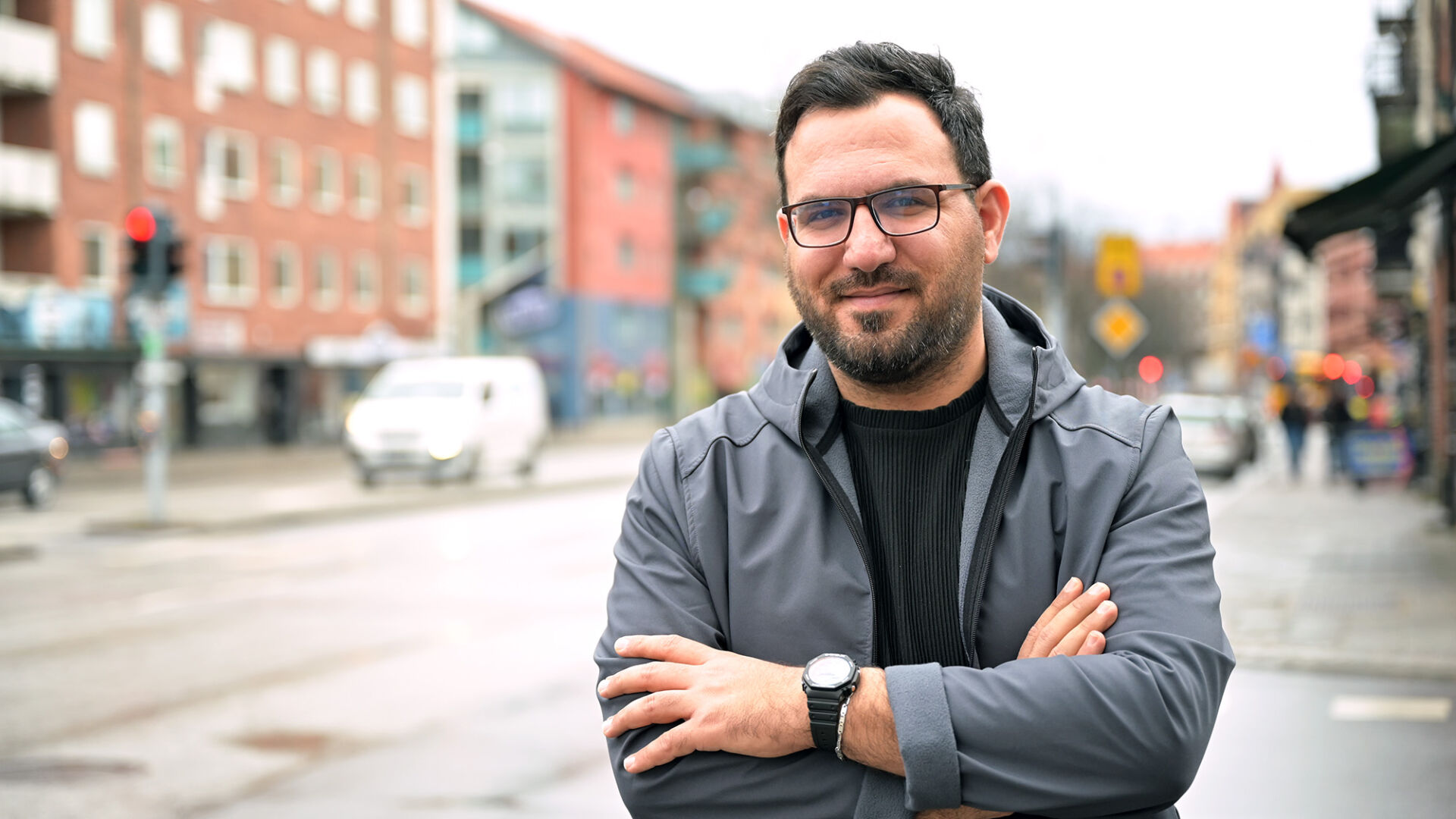
You’ve reported on war, on protests, on politics that put your life at risk. But you also write about fashion, food, and everyday culture. Why?
Partly it’s a way of protecting myself, reporting only on politics makes you an easy target. But it’s also intentional. I’ve covered fashion shows built entirely around secondhand clothing, meant to raise awareness about recycling. I’m currently working on a video story about a fashion designer in Basra. I like telling these stories because they’re about people who are struggling, people nobody pays attention to, and there’s something almost revolutionary about that, in a city like mine.
People outside Iraq are often afraid to visit, because the only stories that reach them are about conflict. But that’s just one side of the country. Talking about fashion, about ordinary life, is my way of saying: we are not only the news you see. There is another Iraq too, and it deserves to be told.
You started as a vet, but now you’re a journalist, what inspired you to become a journalist?
As I mentioned earlier, I continued practicing both veterinary medicine and journalism side by side until December 2018. That year marked a turning point. During the massive protests that erupted in Basra, I found myself at the heart of the story. I was the only journalist on the ground who could effectively deliver the protesters’ voices to the world. Foreign journalists faced significant challenges in accessing the area and staying long enough to capture the full picture. I realized that I carried a profound responsibility—to bear witness and to tell the stories of innocent people who had no other way to be heard.
At the time, I was splitting my days between my clinic, treating animals, and rushing to the field to cover the protests. It was exhausting, but it also clarified something essential for me: journalism was my first love, my deepest passion, and the field in which I truly wanted to grow and make a lasting impact. I knew I had to make a choice, and I chose journalism.
Iraq is, in many ways, a « goldmine » for stories. Every morning I wake up, I am reminded that countless untold narratives are still waiting to be shared—stories of the voiceless, the innocent, and those who have been deprived of their basic rights. That is what continues to inspire me most: the belief that every story matters, and that I have the privilege and duty to tell them.
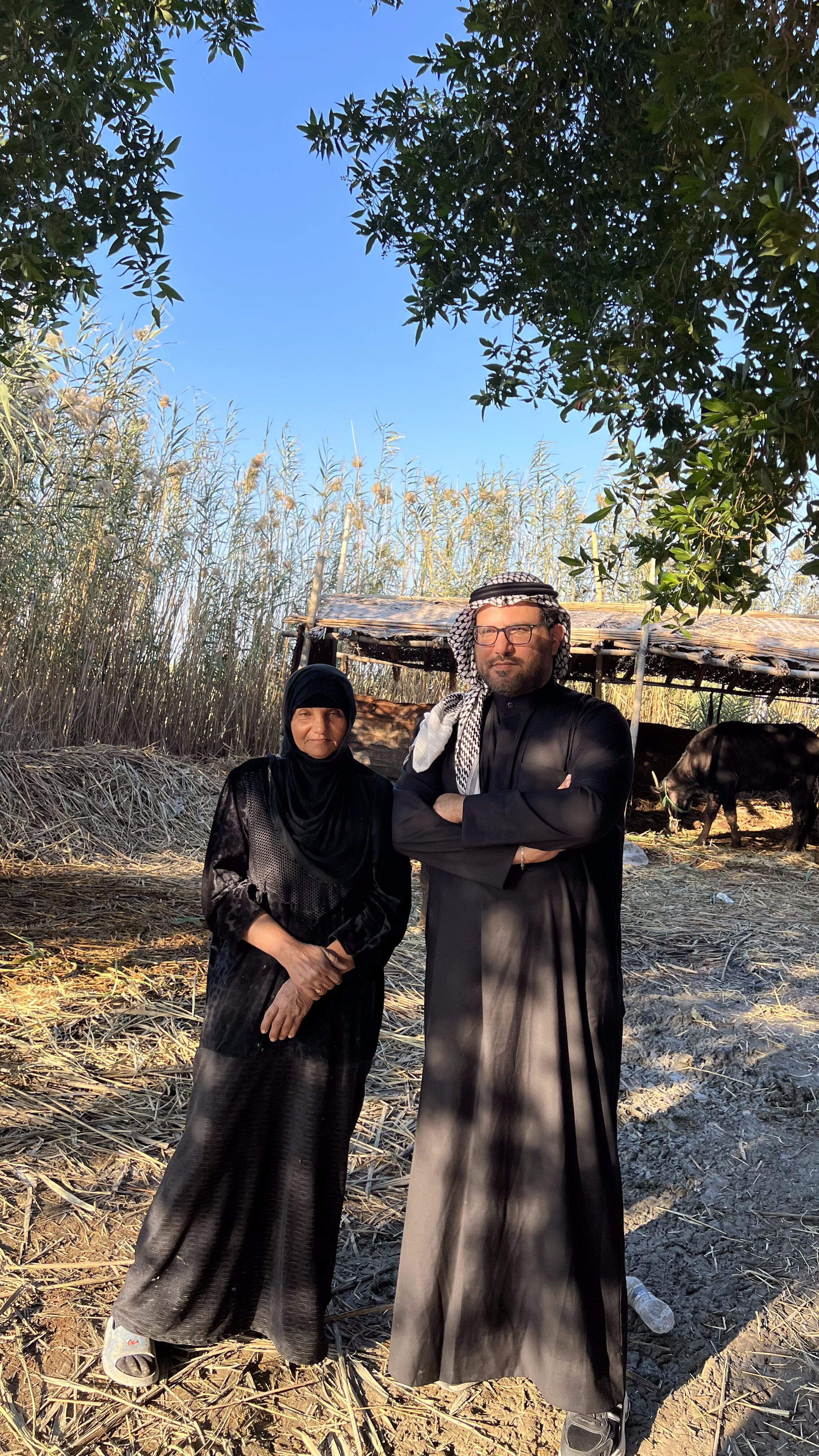 How has relocation affected your job, and has it changed how you see yourself professionally?
The relocation had a significant impact on my professional life. In Sweden, I was unable to practice journalism as I had before, largely due to the language barrier and the challenges of adapting to a new media environment. I tried to find work locally, but the opportunities were limited—employers required very good level in Swedish, and media education, or extensive experience covering local issues, all of which were difficult for me to acquire in a short time. As a result, I continued my reporting by traveling outside Sweden to cover stories, ensuring that I could keep doing the work I love.
For me, journalism is not just a job—it is who I am. I could not simply switch careers, so I had to find ways to stay active and relevant. That determination kept me going. Still, I cannot deny that during this relocation period, I often felt isolated from the world of journalism I had known my entire life.
Being removed from the field I was so deeply connected to was professionally tough. Yet, there were also silver linings. The experience brought many positives and opened doors to new learning opportunities. I engaged in summer workshops and writing classes that enriched my skills and broadened my perspective. These experiences, though born from displacement, ultimately strengthened my career and reminded me that growth often comes from the most unexpected circumstances.
One experience that stayed with me was a writing workshop on a remote island, about fourteen of us, staying for a few days in a place with no close shops or supermarkets. There was a tiny kitchen where they offered us Swedish food but sometimes we would send our colleague to drive the bicycle tens km away to buy some ingredients to make ourselves tasty food for all of us, especially since many of us were coming from middle east and Iraq, where food is “another world”, tasty, oily and with spices. It sounds small, but that isolation gave me something I hadn’t had in years: space and time to actually think. It’s very different to try to reflect on your life, your career, your future, in the middle of a crowded, noisy existence. On that island, I could finally slow down enough to really talk to people, and to understand a culture different from my own.
If you could speak directly to European decision-makers about supporting human rights defenders like yourself, what would you want them to understand?
I would want them to understand that this is a shared responsibility. Human rights defenders carry the voices of people who otherwise wouldn’t be heard, and that voice needs to be kept alive. Supporting mobility and visas for HRDs isn’t just about giving us a place to go; it’s an exchange. We also give something back, we learn new cultures, we contribute to the communities that host us.
While I was in Malmö, I visited schools to talk about freedom of speech, including in the Middle East. I engaged with the community, shared what I knew. The students asked honest, curious questions, about my home, about politics, about the differences between my country and the wider region. Some of them wanted to know what it takes to become a journalist in the Middle East. My answer was always the same: start by understanding your own country first. Only then can you know whether, and how, you’re able to do this work.
Azhar Al-Rubaie is an Iraqi freelance journalist based in Basra. His work has appeared in Arab and international media outlets covering conflict, society, and human rights in Iraq.
