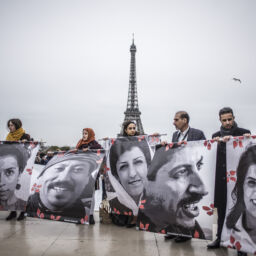

The tools of a human rights defender are simple ones: a camera, a phone, a signature on a statement, a lesson in a banned language. This autumn, each of them has been used as evidence against defenders in Iran.
On 13 August, human rights defender Mehdi Mahmoudian was sentenced in absentia to eight months in prison for “propaganda activities against the state.” Part of the evidence was his own writing from inside Evin prison, describing how elderly prisoners and defenders were shackled and moved by bus during the June 2025 air strikes. He had already served five years (2009-2014) for documenting abuse at the Kahrizak detention centre, a site that was closed after his work came to light.
In late July, a sentence of two years and six months was confirmed against Sajad Haeri, a Kurdish language teacher from Ilam province, for “propaganda against the state” and “spreading disinformation.” On 10 August, his lawyer asked the Supreme Court for a retrial, but he remains at risk of imminent imprisonment. His brother, Ahmadreza Haeri, has been detained since May 2023 for his campaigning against the death penalty.
ProtectDefenders.eu received information on three other cases, showing how far the repression against individual defending rights in Iran extends.
Photojournalist Yalda Moaiery, who has documented conflicts, women’s lives and the 2017 protests for two decades, learned on 8 August that she had been sentenced in absentia to 15 years in prison for “activities in furtherance of the interests of the Zionist regime.” The court’s reasoning rests on her photographs and on sending them to “hostile media.” The verdict also bans her from media work and confiscates her camera. It was handed down under the espionage law amendments introduced in June 2025.
Najmeh Amini, a 23-year-old accounting student arrested during the January protests, has reportedly been sentenced to death for blasphemy over a social media post. A second court gave her more than 12 years on national security charges. Her death sentence is not final and can still be appealed. In a recording attributed to her, she asked only to be heard: “be my voice.” Rights groups warn that the case risks normalising capital punishment for peaceful expression.
Inside the prisons, people are refusing to stay silent. On 13 October, inmates in 66 prisons held a hunger strike for the 142nd consecutive Tuesday as part of the “No Tuesdays for Executions” campaign. It began in Ghezel Hesar prison and spread across the country. The campaign reports at least 2,230 executions between October 2025 and October 2026, including four people who were under 18 at the time of their alleged offences. Its call to the international community is clear: establish concrete mechanisms to stop the executions.
A lens, a keyboard, a classroom, a prison cell: none of them is a weapon, yet each has been treated as one. We stand with those who keep documenting, speaking and teaching despite the risk. Their voices should not be left to carry the burden alone.