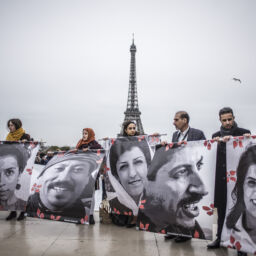

The 2nd November, has been the International Day to End Impunity for Crimes against Journalists.
Many journalists, as human rights defenders, expose abuses, give a voice to those who are not heard and hold power to account. For this reason, many of them face threats, harassment, arrest and violence, and too often those responsible are never held accountable. On our Index of Alerts, we see every day the number of risks journalists face simply to do their work.
To mark this day, we have teamed up with Reporters Without Borders (RSF). We asked them to clarify why journalists are also human rights defenders, and how freedom of expression is at the heart of both roles. We also asked about the risks journalists face in their daily lives, where the gaps in their protection lie, and what the EU can do. And we look at the Predators of Press Freedom campaign and what it reveals about the threats facing journalism today.
Why are journalists human rights defenders?
Journalists are inherently human rights defenders: only in performing their journalistic activity, “individually or in association with others, [they] promote and strive for the protection and realization of human rights and fundamental freedoms at the national and international levels” (‘article 1 of the UN Declaration on human rights defenders). Indeed as Hannah Arendt pointed out, freedom of opinion is a farce if the public conversation is not based on facts. That is precisely the social function of journalism: to report the facts and accordingly enable citizens to self-determine as citizens.
How often are journalists targeted by authorities because they expose human rights violations, and what tactics are used to silence them?
The targeting of journalists has kept growing in the past years. As the RSF World Press Freedom Index has evidenced in the past years, press freedom around the world is more and more being threatened by the very people who should be its guarantors – political authorities. The situation is considered for the first time in 2026 as difficult or very serious in over half of the world’s countries. In 2002, 20% of the global population lived in a country where the state of press freedom was categorised as “good.” Twenty-five years later, less than 1% of the world’s population lives in a country that falls under this category. Journalists suffer political repression, they are targeted specifically in the context of armed conflicts, the weaponisation of law to silence them is at its peak, so is perverting journalism for propaganda, including war propaganda, disinformation and FIMI. Moreover online targeting especially of women journalists, also algorithmic marginalisation of journalism on platforms, search engines and AI chatbots are fully part of a repressive apparatus more and more justified fallaciously in the name of free speech pretending trustworthy journalism would be for some militant, for others the new censor.
Do journalists receive sufficient protection as human rights defenders? Where are the main gaps?
On a global scale, improper, insufficient, ineffective protection is blatant against undue legal restrictions on press freedom, de facto turning them into the new standard and making domestic law not the protector of press freedom but against it. The same happens with por protection against undue surveillance and cybertargetting. Political will is also lacking to counter widespread and often systematic repressive practices amounting in more and more situations to core international crimes against journalists, not only in armed conflict situations. Unwillingness to investigate, prosecute and try the criminals results in highest impunity rates. It’s obvious that journalists’ protection in law and practice is blatantly weak and disproportionate to the risks they now have to face and take to perform their journalistic activity.
What is the purpose of the Predators of Press Freedom campaign, and what does it reveal about the threats facing journalism today?
The Press Freedom Predators List builds on RSF’s World Press Freedom Index — which highlights how press freedom has evolved in every country each year — and turns the spotlight around to identify the actors responsible for declining press freedom. And it makes sense to launch it for International Day to End Impunity for Crimes against Journalists. Behind the statistics, the setbacks and the obstacles lie clear lines of responsibility. Whether they resort to physical or verbal violence, legal abuses, intimidation, digital manipulation of the facts or economic pressure, these predators share the same goal: to prevent journalists from doing their jobs and deprive citizens of information from independent sources. RSF makes nothing up — each predator has their own profile, presented as a sort of hall of shame, that shows their background, rhetoric and weapon of choice. Identifying press freedom predators, exposing their methods and documenting their abuses means refusing to let their attacks become normalised. In the face of those who seek to impose silence, RSF will continue to name those who kill journalism.
What should the EU and its Member States do more effectively to protect journalists and hold those responsible for attacks accountable?
Full fledged mobilisation for the effective implementation of the EU Guidelines and other instruments to protect human rights defenders is all the more needed of course. But the vital social and democratic function of journalism demands more. More protection and support on the ground, be it physical, technological, judicial or to counter shrinking or closing space for press freedom. More financial support for journalists, medias including exiled ones and civil society organizations to counter the very generalized attacks on journalism globally. RSF experience and figures shows that appetite for reliable information, ie fact-based, is not only high, it’s increasing, including in closed countries. We are at a turning point for journalism and more broadly for our fellow citizens’ freedom of opinion. The UE and its member States have to be present at this rendez-vous with history.
Journalists are human rights defenders. They expose abuses, defend the public’s right to know and, for that reason, pay a heavy price: threats, harassment, exile and violence, most often without anyone being held accountable. Protecting them means treating them as such: with the same emergency support, the same options for relocation and the same political attention that other defenders should be able to count on, and with a clear commitment to end impunity. The EU and its Member States have the tools to do this, and now is the time to use them.
On this International Day to End Impunity for Crimes against Journalists, we stand with the journalists who keep reporting despite the risk, and with those who have had to continue their work from exile.